Sunday, March 4, 2012

SEX, AIDS, FAMILY PLANNING & EARLY PREGNANCY


As a continuation to the blog I wrote a few weeks ago about Relationships, I wanted to follow up with some projects I have been apart of that target early pregnancy and the spread of sexually transmitted diseases, including HIV/ AIDS.  Despite the fact that condoms are readily available most men choose not to use them. They won't admit this but after talking to the ladies it appears the usage is limited. Early pregnancy is a huge problem here as well as the spread of STD’s.

Project Diobe:

Diobe is a small town located 18km from my small little village. Every Wednesday people arrive from around Senegal, Guinea Bissau, Guinea, Mali and the Gambia to trade and sell goods.  Because there are so many people coming and going it is a optimal place for prostitution. USAID reported that this area  is one of the few places, in Senegal, that has a higher prevalence of HIV/AIDS.


The Diobe Market

In Diobe, Packing up a bus (picture by Chealsea Moeller

Having previous success with a local theater group, I organized a day to educate this market community about HIV/AIDS. We invited other NGO’s to join us and had a local testing center come to offer free testing.  We interviewed participants on their knowledge of sexually transmitted diseases and AIDS and the results were quite eye opening. We had an array of responses for ways one can contract AIDS including kissing, sharing food, and giving a massage.  Only a few people were able to explain how the HIV virus is different than other diseases and less than half knew how often they should get tested.  The results of these interviews showed that it is necessary to continue this type of education.  Out of the 34 participants that got tested, only one was positive.

With the local doctor and health educator (RtoL)

Sam &Ally passing out condoms and encouraging people to get tested


Testing Crew

Theater Group sketch about AIDS


Project Family Planning:
Myself and five other volunteers organized a series of trainings that aimed to educate men about the benefits of family planning. Many women do not have a choice when it comes to the number of children birthed. They rely on their husbands for money to buy birth control and more often than not they do not provide funding. I can not tell you how many times I have been  approached by women to pay for their contraceptive (it cost a dollar for a three month depo shot). It is this reason why we thought targeting men might be a better way to inspire change. The trainings were all very successful and brought up interesting and controversial issues.
Like the current birth control protest in the United States many religious people feel that it is against God’s will to use family planning methods.  This issue was brought up on several occasions and one of the local health agents working with us did an excellent job at responding to this type of question.  Their argument was simply that "God tells you to take care of and provide for your family.  If your children or wives are dying due to malnutrition, or you can’t afford to send all your children to school, or give them proper clothing then you are not doing your job as a husband." The other argument was natural spermicides.  Why does God provide natural medicines if he does not want you to use them.  i  Both of these arguments really opened up the room for discussion and though there are always the stubborn men that always disagree, there were many who found insight in what was said.  In fact, after our trainings, one of the hospitals saw a rise in Birth control purchases.

Condom Demo 101

Activity about providing for your children. We broke up everyone into "families" some with 20 people and some with 2. Then we gave them the same amount of bread and told them to feed everyone. It was a hit! 

Female Condom

Family Planning Group! 


Project Early Pregnancy:

There is not a day that goes by that I don’t bring up this issue to someone. It breaks my heart to see 13 and 14 year-old girls pregnant.  In nearly every case they have to drop out of school to take care of this child who has no acknowledged father. Because they have brought both shame and burden to their family they usually become the main woman worker of the house.  Every woman that I know who has had a teenage pregnancy is unhappy and tells me how difficult her life is.  It is frustrating that her child will be limited because of her status.
I have had a series of events that have targeted both young girls and boys to talk about the risks of sex.  We have a big event coming up at the local high school that will talk about delaying sex and over-coming peer pressure.   This past week we had a seminar for 20 elementary school girls to talk about empowerment and career opportunities. We challenged them to think about what it means to be an African woman, what characteristics are important and what things can prohibit them from achieving their goals. We talked a lot about early pregnancy and how it can ruin your dreams and life.  Hopefully these girls will think twice when they face these types of situations.

Group Shot, Girls Seminar 

Making Empowerment Bracelet 


  From just the number of young mothers in my village, I know these children are having sex. To look the other way and not share knowledge of protection is, in my opinion, the bigger sin.  After having these types of conversations, many people do see the importance of sex education with younger children.  My hope is that as people become more open minded future generations will have more opportunity to implement these concepts into their lives.


Monday, February 27, 2012

The Woman Weeps

This is a follow up to my last blog post. It is a poem I wrote a while ago when I was frustrated with the way a good friend of mine is treated. enjoy

The woman weeps
her calloused hands
wipe away the tears

No one sees her
for she cries alone
with her laundry pile near

Her harsh words
have damaged spirits
for her children fear her

They understand one thing
and seek to escape
her unfolding wrath of hate

Her brutal hands of stone
leave un-healing marks of pain
to stop it would be too late

For the anger grows more each day
it rises from the ashes of blame
and she does not seek to understand

the inequality of her gender
of her life and of her dreams
slowly dissipate into space

No one knows her story
and there is no point in sharing
for true feelings mean nothing here

So her anger continues to defy
her miserable life of lies

and the woman weeps
for all things felt
but left unsaid

and the woman weeps
for her tormented soul
and secretly wishes
she were dead!

Monday, February 20, 2012

Relationships, Broken Hearts, Men, Women & Love

I have not had regular access to the internet and have been unable to post.  However,  I have been writing a lot and have three new entries to share. I will be putting them up in the next couple of weeks.  Enjoy


No matter where you live or what culture you were raised in, the majority of human beings deal with relationships, heartbreaks and love.  Being here and having the opportunity to live in a local community and date a host national has given me a different perspective on relationships, standards, gender roles, and love.  It has also brought to awareness a particular sense of gratitude for my own upbringing and freedom.  I want to apologize for writing so much about the oppression of women. I never planned to revolve my blog around this subject, but lately the stories I feel most inspired to share are just that. 

The words relationship, boyfriend, and girlfriend have a very different connotation here than they do in America.  Most will agree that in America when you are in a relationship it means that you are dating one person unless agreed upon otherwise. Communication is essential and trust is even a bigger. Cheating is looked down upon by society and is a likely cause to end a relationship.   Here it is very much the opposite. Cheating is a common practice and though people do not necessarily like it, they accept it.  I have spent a lot of time talking about this subject to both men and women (teenagers and adults).   The chance that your Senegalese boyfriend (muslim or catholic) is having or has had sex with another person while dating you in pretty darn high.  

Some of my male volunteer friends have had some interesting conversations with Senegalese men.  One friend told me that his tailor asked him why the volunteers (male) do not want to  “play” with the women here.  His quote “the women of village “A” want to play. You just tell me whom you want and I will help you.:  When explained to this person that he was in a relationship and was not interested, the man did not understand.  He explained how he was also in a relationship. This type of thinking is not uncommon.


In trying to understand why this is so accepted I talked with a good friend of mine.  She was born and raised in Sierra Leone, yet had the opportunity to live in America for much of her adult life. She explained that African men love their girlfriends and want to marry them however they commonly sleep with other people. It doesn’t mean they don’t love their girlfriends but before marriage they don’t see the necessity to remain loyal to one woman even if they have not had sex with her.  It is something she told me that she has learned to accept.  She also talked about the lack of effort made by a man once he has your commitment (sexual or not) And romantic gestures such as giving flowers or love letters are very unlikely.  Love here is reflected in action rather than emotions.  If you are a man and you love a woman and want to marry her you work hard to have money so you are able to support her and your future family.  Women show their love by working hard, being obedient, and domestic.    


 So you would think once people get married the sleeping around would stop.  Unfortunately, it does not.  In a polygamous society, such here, men use the excuse that they are looking for another wife as a means to justify their sleeping around. For Catholics this excuse is not accepted thus men who choose to have affairs do so much more discreetly. Either way the consequences for these types of actions mostly affect the women.

I have seen girlfriends and wives act out against this and the results have been discouraging.  My host sister went crazy when she found out her husband was talking to another women and tried to hit him. The result was that he beat her. My friend found out her husband was taking a second wife and spoke out to him only to be hit. A girlfriend found out her boyfriend was sleeping with other women, called him out but stayed with him anyways.
 In America a woman has the right to leave her husband if he is unfaithful to her.  Unfortunately women do not have the resources to pack up leave. They are dependent on their spouse for financial support.  Also women who do choose to leave and return to their father’s house are often times looked down upon.  Being a woman in this culture means putting up with whatever your husband does and if you don’t like it then you must find a way to deal with it. 

I can’t help but to admire a woman who has an unfaithful husband and is stuck in the situation.  She has really no choice but to carry on, take care of her children, and find a way to cope.  Emotions are not expressed here! Besides children, the only time you will see someone cry is at a funeral when they are mourning for the deceased.  They are taught from a very young age that repressing how you feel is the way you live.  The result is that women have very little self-esteem, refuse to stand up and talk, and do not complain.  I know from my conversations that there is not a lack of feeling. The women here do feel and they do get hurt and upset when someone wrongs them. They choose to ignore it, let it go and move on.  You may think this is healthy, but in my observations I have seem many women who turn all this hurt into anger.  They let it out on their children.  A good friend of mine is a perfect example of this.

She was the youngest daughter of 7 girls. Her father died when she was 13 and was then married off to someone twice her age. She is an extremely intelligent person and loved to study. This change ruined her life and after being married to this older man and having a child, he died. She was 19 when she moved back with her mother who had recently re-married.  Now with a child and no financial support and her mother’s new husband was quick to marry her again.  She had three more children and is treated poorly by her new mother and law. She does all the laundry, cooks all the meals, milks the cows, pounds the rice and every other task women do here. The difference is that no one helps, her husband gives her no money and spends most of his time taking his motorcycle to watch soccer games or to parties.  She never complains but after several conversations with her, my heart is full of sadness for her and her situation. I recently wrote a poem thanks to her inspiration. 

I will post the poem in my next post...stay tuned! 

Wednesday, December 28, 2011

Current Garden Project

Hey Everyone,
Here is a link to a project I am currently working on. It will be the last thing I complete before leaving village. Please take some time to check it out and donate if you can!

Thanks
http://appropriateprojects.com/node/954

Monday, December 26, 2011

Female Circumcision


This is a topic that I have yet to discuss with my fellow community members until recently. It is a controversial issue worldwide and one that often leads to an emotional debate.  Female genital mutilation (FGM) is where women have their clitoris and/or their inner and outer labia removed.  It is currently illegal in Senegal but after a recent incident I have come to understand that it is something that happens quite frequently. 

Last year, I wrote about male circumcision and the ritual that the boys partake in.  It is one of the most interesting cultural practices that sill exists today, especially as Pulaar culture is slowly being replaced by globalization.  At the time I was learning about this practice I also asked if girls had a similar ceremony. Their response was NO, absolutely not. It is illegal to cut girls.  Being naive and new to the culture I felt content with the answer and did not dive deeper into it.  

It was not until this past week that I learned this practice does in fact take place. The shock of discovering this brought up many different emotions. The consequences to this illegal cutting are one of the most depressing realizations I have faced throughout my service. The story goes as follows:

One morning all the uncut girls in a small village (ages 6 months to 5 years old) are gathered in a grandmother's rooms located in a small hut.  Only a few mothers are allowed in and it's secrecy is only discovered after deathly screams are heard around the compound. These girls have no idea what is going on or why they are being deprived of their female organs.  All they know is that is hurts! And it hurts a lot!  There is no doctor present because if discovered they would go to jail.  So it is no shock when a four year old girl has an infection and they do nothing except tell the poor child that "god is good and to pray for him to heal you".  Nor is it a shock when the girls don't pee for 3 days because it hurts so badly.  And when a girl finally dies because "it was god's will" there is no one held accountable. 

I have heard it argued that FGM is a traditional practice and we "westerners" have no place to fight against it.  And I have several responses to this:

1. Women here claim that they must cut their daughters because if they don't they will not be a good Muslim woman.   (Please correct me if I am wrong but I believe many Muslim scholars argue against this practice and there is in fact no verse in the Koran that supports the cutting of women)  

2. Today there is no traditional practice being carried out when the girls are cut. They are too young to understand, it's done in secrecy and they don't seek proper medical care. 
There used to be more tradition involved because girls where cut when they came of age (12 or 13) and it was a ceremony with the grandmothers who would talk about the important qualities of being a Pulaar/ Muslim woman.  However his no longer takes place, the cultural component has been lost.  

3. I personally do not agree with any type of circumcision or altering of the body but at least for boys there is a major health benefit that results. For girls it is removing the part of their body that gives them pleasure during sex. It has nothing to do with making them healthier but further supports the notion that women are created only for the pleasure of men.  

To me this is a human rights issue. No human being is better than another, no matter what sex you are.  It infuriates me that girls are taught to have no self-confidence and from a young age are told they are worthless. What is more frustrating is the ignorance among mothers. They have no opinions of their own but have literally been feed lies their entire lives.  

You may criticize me and say it's not my place to fight against this injustice. One also might argue that I am trying to force Western ideas on a country that have their own.  And you know what, I probably might have said the same before this experience but I have come to understand that our" western ideas" work.  Though it's important to say that I don't agree with all of them, there are many that should be shared.  The fact that we women, in America, can get a free education, can easily attend college and pursue a career in whatever we want has, no doubt, significantly increased the success of our country.  It has not always been like this and many strong women before us have had a hard fight, but it is an intricate part of development.  Now that we have achieved it is our job to share and educate our sisters around the world.  The fight against FGM is just a start.  We are women who deserve to have all of our organs. We deserve to enjoy sex the way it was either created or has evolved to be practiced. We deserve to be confident, we deserve the chance to pursue an education and be successful. We deserve the opportunity to contribute to the world and make it a better place! 


Fight against FGM!
http://www.tostan.org/ - organization the works in Senegal against FGM. 

Wednesday, December 7, 2011

Politically Correct!


A recent blog post, written by an x- peace-corps trainee, fired up some intense emotions among volunteers here in Senegal.  Apparently her one-month experience as a trainee gave her enough insight to criticize Senegal volunteers and their administration.  After reading her blog I was offended by the preposterous claims that she made.  Although I understand her problems most likely stem from some deeper personal issues, I find it insulting that her approach was to publicize her account as an accurate representation of Peace-Corps Senegal.

The reason I am taking time to discuss this on my blog is because it raises an interesting question about being politically correct.   I find this phase quite interesting and think it’s worth looking at.  This term in America has become widely used and often times misused.  Americans must be constantly on their toes, careful not to offend anyone.  One could easily argue that this tyranny of hurt feelings toward the individual (which is growing rapidly) is destroying free speech and thought.   Not that I strive to offend others, but the freedom to be offensive is a constitutional right.  If you want to be a jerk then you are allowed to be a jerk. I think it is important to understand that just because a few people choose to live in a way the reflects negative on themselves, does not mean that they represent the attitudes and beliefs of the whole.

If you can picture a society the complete opposite of America you will find yourself imaging the interactions between people here in Senegal.  The culture here, to any American, would appear offensive. This impoliteness does not stem from a desire to hurt others, but it is just how things are.  It is by far, one of the most difficult components of adjusting to life in village.  People do not filter what they say and if challenged to do so respond with curiosity and confusion.

 Sayings such as “your fat”,  “your ugly”, “you can’t cook” “you don’t know how to do this or that”  “your white so you should give me money or buy a well” are things you here on a daily basis.  Also both children and adults constantly chant the word “toubab” “toubako” “touba haacko”.  “Toubab” is an Arabic word that actually means doctor, however very few Senegalese people know that.  The word “Touba haacko” means leaf pants and can be linked back to when colonists arrived and used leaves to wipe themselves when using the restroom.  Whatever the meaning, volunteers are called this wherever they go. It’s both offensive and annoying and it takes time to get used to it. It also takes some time to learn appropriate responses.  From an American perspective one might think to stop and explain to the children that calling someone this name is offensive and not okay. However this is not how it is done in their culture thus being light hearted and joking with a response such “black children” is totally acceptable. It is not offensive to people to call out obvious things.  (now if one where to call someone a slave, that would be inappropriate and I will discuss this in my next blog post in relation to the pulaar caste system)

There has been much debate amongst volunteers as to whether the word toubab is directed towards people because they are a foreign or because they are white.  After asking some Senegalese people they will in fact admit that the word is directed towards people who have white skin.  Fellow volunteers who are black do not usually get called this unless they are with a group of white volunteers.   Now because the majority of Senegal Peace Corps volunteers have white skin, you can understand why parts of training are focused on addressing this issue.  The trainee complains that after talking to administration about what she felt was discrimination against colored volunteers that they did absolutely nothing.  This claim was probably the most insulting.  Volunteers and those in administrative positions do their best to make sure the needs of all volunteers are being met.  Recently a peer group has been established to address the needs of those volunteers who face other challenges such as being Asian, Black, and Hispanic etc. as well as targeting those who are homo and bisexual because it is true that they face struggles not known to someone like me. Just as female volunteers face different challenges than male volunteers. (also addressed in training)

Though, after spending months at a time in village, volunteers may say things that, to Americans, appear completely inappropriate, they in no way are racist.  Volunteers do not think they are better than Senegalese people or black volunteers.  Village life is hard and makes you a little jaded. I feel that a volunteer is justified in saying how they feel, even if it may appear insensitive to others.  Though in her blog she does not directly call volunteers racist, she sure does say things to indicate it.  I can only speak for myself, my friends, my region, and the volunteers that I interact with, but I feel like we are most likely some of the least likely people to be termed as racist.  We are giving two years of our lives, to live without electricity, running water, personal space, our native language and our culture to help promote projects that are created to better the living conditions of those who are constantly fighting starvation, malnutrition, and deadly diseases. 

Unfortunately this trainee will never get the opportunity to experience what this life is like and because she made accusations without understanding all of the facts she has portrayed the program of Peace Corps Senegal in a bad light.  I think it is unfortunate that some very incredible people, such as our country director, have had to face some intense criticism over a trainee who could not hack it.  From the perspective of someone who understands the value of being politically correct and then being thrown into a culture where being politically correctness means absolutely nothing, I will argue that there is a balance! 

Every single person is different and nothing will every please everyone.  As Tom Robbins says “humanity is offensive” and it is a part of life.  It is not the governments job to make sure people do not hurt other peoples feelings.  We as human beings have a choice, a choice to act and speak in a way that lifts up others. We also have the choice to embrace the positivity thrown at us and reject the negativity. We have the ability to understand that people oftentimes do and say things because of their own restrictions or problems.  It takes practice but one must learn how to receive things without letting it affect them so personally. 
 There is a time to recognize the difference between a situation where we must stand up and fight injustice verses fighting against a person’s ignorance and insecurities.

I took the time to write this blog because I felt it was important to share how differently cultures vary and what it is like living in village.  I also felt that it was necessary as a volunteer who respects the organization she works for to stand up and speak on behalf of my experience.  Hope you enjoyed reading…. until next time! 

Monday, August 29, 2011

There are Challenges and there is Hope!

It is rainy season here in Senegal.  The fields have transformed into a beautiful painted landscape of greens and yellows and the crops are finding height in their growth process. Everyone is busy working in the fields and tending to their gardens. I remain, as always, the outsider observing and trying to find my place.  Ramadan is almost over and once the holy day is celebrated, drinking and eating will find its way back into the normal daily routine.  I will not go into too much detail of my Ramadan experience because I blogged about it last year, but I will quickly say that this year was incredibly different. I think maybe the romantic idea of fasting and witnessing another religion has slowly worn off.  Instead I found myself in  multiple debates about what it means to truly fast and often times had to defend my beliefs and the choices I make. 

I have a hard time with those who fast and then complain constantly that they are tired, hungry or ill. It drives me crazy when they come to me  seeking medicine because they have a headache.(because they worked in the hot sun with no food or water)   It infuriates me when men tell their pregnant wives they must also fast and I feel the wrath of Jenae about to unfold when they fail to provide food for their children, who are too young to fast.  These things, in my opinion, go against what fasting is all about.

For Muslims the goal is to seek nearness to Allah by not eating or drinking during the day, abstaining from sex and smoking and making an effort to prevent thoughts of anger, evil or malice.   It is also the month when the first few verses of the Koran were revealed so it’s received in a very spiritual way.  It is also said that this time should be spent dividing what you have and sharing it with those less fortunate than you.  It would be unfair to say that everyone here fails to fast in this way. There are many people who celebrate the holy month and gain much from the experience. Unfortunately for me, this year was spent working in the health hut.  (My village finally got medicine) so my experience dealt mostly with the sick. 

Speaking of the health hut, it has been a wonderful experience to finally do my job. I have been waiting my entire service for things to finally get situated. Now I am able to witness the health issues on a more personal level and better understand how and why particular problems arise.  My health worker is a little difficult to work with and I am certain being a woman has much to do with it.  I am learning how and when to speak up and seeking more encouraging ways to offer my wisdom and insight. 


The biggest problem right now is Malaria. It unfortunately is most common in children. The first week we started working we had 9 cases in 2 days. Fortunately it is free for a rapid test and the treatment for simple cases so we have not seen any children die.  However in other villages this is not the case and despite the governments effort to eradicate this disease it is still a huge problem.  I have become quite aggressive when it comes to talking to parents about protecting their children.  I do not think any excuse is valid when it comes to justifying why their children are not sleeping under nets.  I have become the Malaria Prevention Nazi and though my words may seem harsh it does seem to have an affect.  


 For example my 2 year old host niece falls asleep before everyone else. Instead of taking her inside and putting her under a net, she sleeps outside exposed to the biting mosquito (worst insect ever).  I tried talking to them and encouraging them to put up a mosquito net, but it did not work.  Finally I started doing it myself. Every night for about a week I would take her and put her under the net. Then I left for a couple of days and when I returned, I was surprised to see that they were carrying on with the ritual.  I was so excited and it gave me hope to continue the fight.


 There are many challenges, but one of the most frustrating is the lack of desire to prevent diseases. I think it is the combination of ignorance and  accepting it is a part of life.  These two issues are extremely hard to face and we as volunteers spend enormous amounts of time talking about malaria prevention and other disease. 


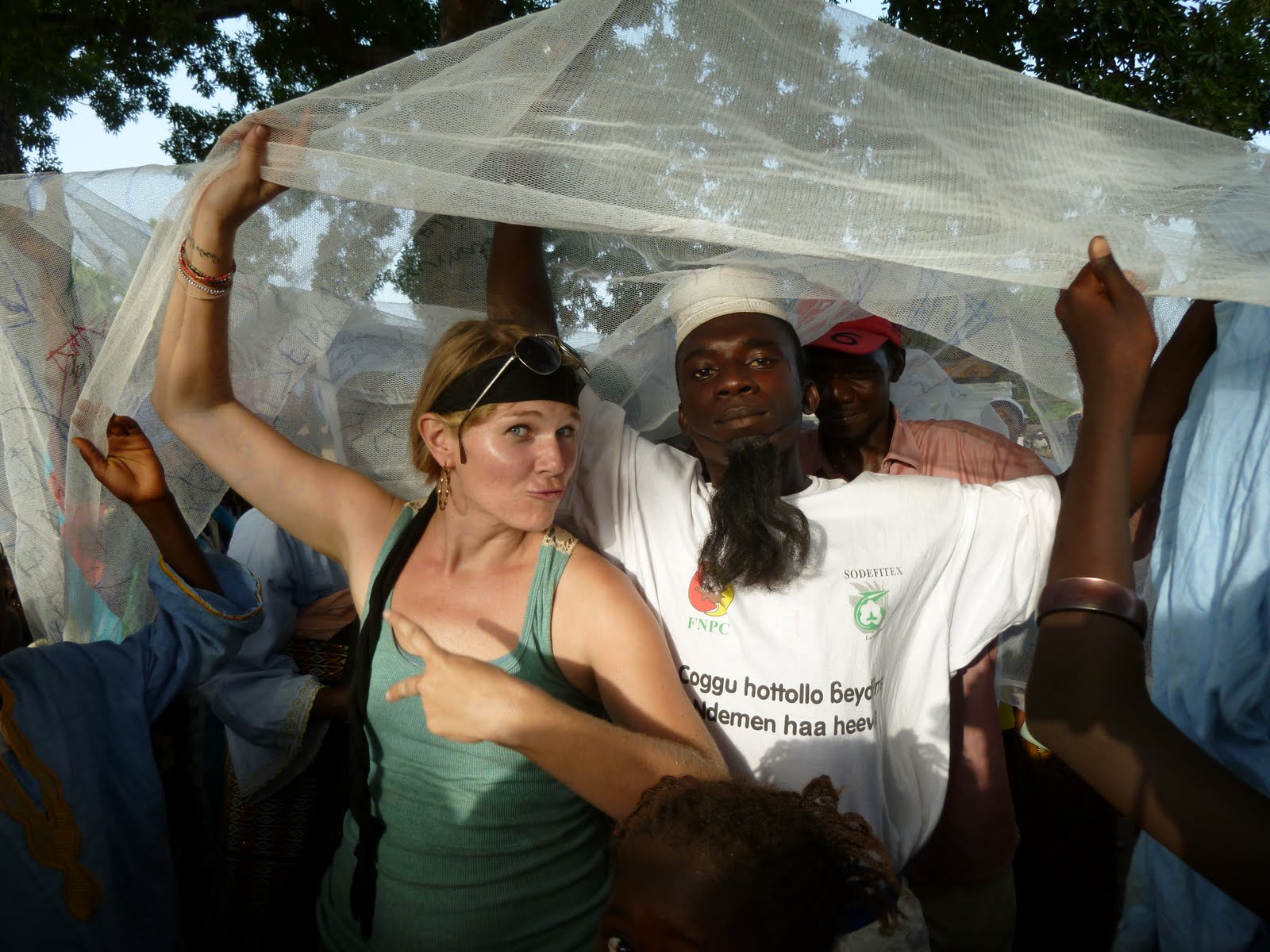
The volunteers in my area recently took part in a 4-day Malaria tour née where we set up a fair style convention in collaboration with a local theater group. It was a great success and we had a lot of fun making Neem cream (natural anti mosquito cream), coloring mosquito nets, and talking to communities about the importance of prevention. The pictures below are from this event. 
  This last month in my village, I also had the same theater group come and perform on a weekly basis. They did different skits of different health issues and we then talked about ways to prevent illnesses such as diarrhea, infections, malaria, and AIDS. It was fantastic and we had a lot of fun.  So despite the frustrations and challenges, there are good things that are happening and I am content being in this place. Thank you for reading and stay tuned, the next few months will be full of fun events and I will soon have much more to share.


STOP MALARIA NOW!   pic by Cara Steger


Theater Group 

Dance party under the mosquito net after the sketch
Photo take by Cara Steger

Exile Malaria!!! Picture by Cara Steger
A women's blog in which I read regularly shared this quote 
"The roots of the tree of life are alive as ever even if the shoots appear tortured and burnt….” – Chief Clyde Bellecourt.

And her response was this...I thought it was beautiful and had to share: 
."much of our inner forest has been harvested, abused and cut down — all in the name of the fear of scarcity and profit. But, the roots are strong…the tree of life will not give up. Whether we want to sit under the shade of its loving canopy is our decision." 

If you are interested you should check out her Blog site. She is a former peace corps volunteer and her insight is invaluable. 

http://madhupamaypop.com/